
The Evolution of Aerospace Turbine Blades: Materials, Applications, and CNC Innovations

The Evolution of Aerospace Turbine Blades: Materials, Applications, and CNC Innovations
Aerospace turbine blades are marvels of engineering, enabling modern aircraft engines to achieve remarkable thrust, efficiency, and reliability. Over decades of development, these precision components have become increasingly sophisticated, driving advancements in metallurgy, manufacturing methods, and computational design. This article explores the origins of turbine blade technology, the science behind their operation, the materials that make them possible, and the role that Computer Numerical Control (CNC) machines play in their production.
A Brief History of Turbine Blade Technology
Early Developments
The foundation for today’s turbine blade technology was laid in the early 20th century, inspired by steam turbine engines used in power generation. As jet propulsion matured during and after World War II, aerospace engineers realized that the key to more powerful and efficient engines lay in optimizing the design and materials of turbine blades.
Jet Age Innovations
The dawn of the Jet Age in the 1950s introduced new alloys capable of withstanding extreme temperatures and stress levels. Early superalloys such as nickel-based blends enabled jet engines to operate at higher temperatures, improving their thrust-to-weight ratio. Over time, blade cooling systems grew more complex, incorporating tiny internal passages or complex external cooling ducts to keep metal temperatures in check.
Modern Era
Today’s aerospace turbines benefit from computational fluid dynamics (CFD) simulations, allowing engineers to tailor blade shapes with incredible precision. Further breakthroughs in superalloys, ceramic matrix composites (CMCs), and single-crystal casting techniques continue to push turbine blades to their performance limits. These innovations have helped extend engine lifespans and improve fuel efficiency, benefiting both commercial and military aviation.
How Turbine Blades Work
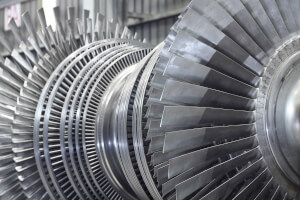
In a gas turbine engine, blades are arranged in multiple stages of rotating and stationary rows. Compressed air mixed with fuel ignites in a combustion chamber, creating rapidly expanding gases that drive the turbine stages. As hot gases pass over the blades, the blades spin at high speeds, generating the mechanical energy needed to power the compressor and, in many engines, provide additional thrust.
Key to this process is efficient aerodynamic design. Turbine blades must be carefully curved and contoured to maximize the energy extracted from the hot gas flow, while also mitigating losses such as turbulence. Because these blades encounter extreme temperatures—often exceeding 1,000°C—they rely on advanced cooling channels and heat-resistant materials to prevent thermal fatigue and structural failure.
Size and Application Variations
Turbine blades vary in size and complexity based on the type of engine and its intended use:
- Small Blades: Found in turboprops or small jet engines for private or regional aircraft. Though compact, they must still handle significant mechanical loads and heat.
- Large Blades: Used in high-bypass turbofan engines powering widebody and military transport aircraft. These can span several inches to over a foot in length and are engineered to manage intense thrust and thermal conditions.
- Specialized Blades: Military fighter jets and supersonic aircraft often employ blades designed for extreme performance, prioritizing acceleration and high-altitude efficiency.
Key Materials Used in Modern Turbine Blades
- Nickel-Based Superalloys: Provide excellent high-temperature strength and resistance to corrosion and oxidation. Often used for the hottest sections of the engine.
- Titanium Alloys: Lightweight and strong, suitable for cooler stages near the front of the compressor and intermediate turbine stages.
- Ceramic Matrix Composites (CMCs): Emerging materials that withstand even higher temperatures than many superalloys, offering potential for improved fuel efficiency.
- Single-Crystal Structures: Advanced casting methods produce blades without grain boundaries, significantly reducing creep (long-term deformation under stress) and extending blade life.
Best CNC Machines and Methods for Turbine Blade Manufacturing
Precision Matters
CNC machining is integral to manufacturing turbine blades due to the need for micrometer-level accuracy. Even slight deviations in shape or dimension can affect an engine’s overall performance and durability. CNC systems leverage computer control to automatically position cutting tools along multiple axes, creating intricate aerodynamic surfaces and internal cooling channels.
Recommended CNC Approaches
- 5-Axis Milling: Allows cutting tools to move in five different directions, making it possible to machine complex contoured shapes in a single setup. This reduces both production time and the risk of human error.
- Electrical Discharge Machining (EDM): Ideal for creating intricate cooling passages, especially in challenging superalloys. EDM removes material through electrical discharges, bypassing many of the limitations of traditional cutters.
- Adaptive Machining: Involves using real-time measurements to adjust the cutter path, compensating for small variances in the workpiece and ensuring every blade meets strict tolerances.
- High-Speed Machining (HSM): Boosts production rates while maintaining surface finish quality. Coupled with advanced toolpath strategies, HSM helps manage heat buildup during the cutting process.
Benefits of CNC in Turbine Blade Production
- Consistent Quality: Automated processes maintain uniformity across large production runs, vital for assembly in high-performance engines.
- Shorter Lead Times: Reduced manual intervention and quick tool changes speed up production, letting manufacturers meet demanding delivery schedules.
- Material Efficiency: Optimized cutting strategies minimize waste of costly superalloys, cutting down on expenses and promoting sustainability.
- Integrated Inspection: Many modern CNC machines feature in-process inspection tools, further enhancing quality control by detecting deviations in real time.
Conclusion
Aerospace turbine blades stand as one of the most striking examples of precision engineering. From their roots in simple steam turbines to today’s meticulously crafted components at the core of high-performance engines, their evolution reflects decades of technological leaps in metallurgy and design. Advanced CNC machining has taken turbine production to new heights, enabling the consistent manufacturing of blades that must endure tremendous thermal and mechanical stresses.
As materials like ceramic matrix composites gain traction and 5-axis machining techniques become ever more refined, turbine blades will continue to push the boundaries of aerospace innovation. This synergy between cutting-edge science and robust manufacturing methods not only fuels the planes we fly in, but also sets the stage for exciting developments in power generation and industrial gas turbines worldwide.