The Ultimate Guide to Tool Identification: RFID, QR Codes & Digital Twins (2026 Edition)

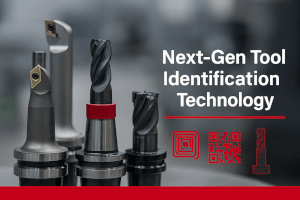
The Ultimate Guide to Tool Identification: RFID, QR Codes & Digital Twins (2026 Edition)
A complete, modern guide to eliminating tooling errors, improving setup speed, and increasing machining profitability.

INTRODUCTION — Tool Identification Is Now a Competitive Advantage
Manufacturers everywhere are battling four constraints:
- Labor shortages
- Increasing part complexity
- Tighter delivery expectations (2–10 days vs 4–6 weeks)
- Rising scrap and tooling costs
In most shops, one of the highest hidden losses comes from tool identification errors:
- Wrong tool loaded
- Wrong tool length or stickout
- Incorrect wear offsets
- Wrong insert grade or geometry
- Duplicate tools mislabeled
- Missing tool life info
- Outdated presetting data
- Operator miscommunication
Even world-class shops report 18–30% of scrap is caused by tool inconsistency.
RFID, QR Codes, and Digital Twins have emerged as the three foundational technologies that eliminate these problems and finally unify tool data across:
- Tool crib
- Presetters
- CAM systems
- CNC machines
- Shop-floor automation
- ERP/MES systems
This guide breaks down everything modern CNC shops need to know — with examples, ROI tables, and real-case studies.
SECTION 1 — What Tool Identification Actually Solves (and Why It Matters)
Tool ID eliminates the top causes of machining inconsistency:
| Problem | Impact on Shop | How Tool Identification Solves It |
|---|---|---|
| Wrong tool loaded | Machine crashes, scrap | Alerts when wrong tool is scanned |
| Wrong length/stickout | Bad tolerances, chatter | Digital twin validates presetting |
| Wrong offsets | Rework, downtime | RFID auto-imports offsets |
| Wrong insert grade | Tool breakage, poor finish | Database enforces correct tool pairing |
| Missing tool life history | Sudden failure, downtime | Tool life tracked across machines |
| Duplicate tools mislabeled | Setup delays | Unique digital identity prevents mix-ups |
| Poor communication between shifts | Inconsistency | All tool data stored in central system |
Impact: Shops typically recover $50,000 to $250,000/year in lost productivity just by modernizing tool ID.
SECTION 2 — RFID TOOL IDENTIFICATION (Radio Frequency Identification)
The highest accuracy, zero-human-error solution
RFID is the preferred system for aerospace, defense, medical, and lights-out machining environments.
How RFID Works
A small chip is embedded into the toolholder or shrink-fit holder. When placed near an RFID reader (on a presetter or CNC machine), it automatically sends:
- Tool ID
- Tool type
- Presetter-measured length & diameter
- Nose radius
- Holder type
- Compensation wear values
- Remaining tool life
- Workpiece/job association
- Serialization data
- Historical usage
This data is directly transferred to the CNC machine — eliminating the most error-prone step in machining.
CASE STUDY: MEDICAL DEVICE MANUFACTURER REDUCES SCRAP 42%
Company Type: Medical implant supplier
Machines: DMG Mori NTX, Mazak Integrex
Problem: Wrong stickout on multi-axis tools causing inaccurate slotting & chatter
Solution: Adopted RFID presetting + toolroom scanning
Results after 90 days:
- Scrap reduced from 11.4% → 6.6%
- Average setup time reduced 22 minutes per job
- Tool crib achieved 100% traceability
- Eliminated 4 crashes valued at $18,000 in repairs
ROI: Payback in 5.2 months
Advantages of RFID
✔ Zero manual typing: Offsets imported into the machine without operator intervention.
✔ Perfect for automated pallet pools & 5-axis cells: Robots depend on accurate tool data for safe operation.
✔ Tracks real tool wear in real time: Controller updates chip after every cycle.
✔ Flexible & scalable: Ideal for shops with 100–5,000 tools in circulation.
Limitations
- Higher upfront cost (presetter + readers)
- Requires RFID-enabled holders
- Overkill for simple 3-axis toolrooms
RFID Performance Table
| Metric | Typical Improvement |
|---|---|
| Scrap Reduction | 20–50% |
| Setup Time Reduction | 30–60% |
| Crash Avoidance | Near 100% |
| Training Time Reduced | 50–70% |
| Tool Life Utilization | 10–20% better |
SECTION 3 — QR CODE TOOL IDENTIFICATION
Affordable, fast, universal — ideal for small and mid-size shops
QR codes are the most accessible entry point into digital tool management.
How QR Codes Work
A QR label (or laser mark) is applied to the toolholder. Scanning with a phone, tablet, or scanner reveals:
- Tool type & photo
- Measurements (L1/L2)
- Job or part number
- Edge prep
- Insert grade recommended
- Remaining cycles
- Presetter notes
- Last operator
- Storage location (cabinet, drawer, aisle)
CASE STUDY: 25-PERSON JOB SHOP CUTS SETUP TIME BY 38%
Company: Aerospace prototype supplier
Machines: Haas UMC-750, VF-4SS, Doosan Lynx
Problem: Operators spending 8–12 minutes locating correct tools
Solution: Implemented QR-coded tool crib
Results:
- Setup time dropped 38%
- Tool retrieval improved by 60%
- Operator onboarding time reduced from 6 weeks to 2 weeks
- Tool duplication eliminated (saved $27,000/yr)
Cost:
QR software + labels = under $2,000
ROI:
30 days
Advantages of QR Codes
✔ Lowest cost: Near-zero hardware investment.
✔ Works on any toolholder: CAT40, HSK, Capto, BT30, ER collets — no limitations.
✔ Improves communication between shifts: All information tied to the tool, not the operator.
Limitations
- Requires line-of-sight
- Stickers can wear off (laser etching solves this)
- Manual wear updates unless integrated with presetter
QR Code Performance Table
| Metric | Typical Improvement |
|---|---|
| Setup Speed | 20–50% |
| Error Reduction | 30–70% |
| Tool Search Time | 50–80% |
| Cost Savings | High |
SECTION 4 — DIGITAL TWINS FOR TOOLING
The most powerful tool technology ever introduced in machining
Digital twins are virtual versions of physical tools, including:
- Geometry
- Holder assembly
- Stickout
- Runout
- Tool wear progression
- Heat behavior
- Deflection prediction
- Life expectancy
- Material removal modeling
Why Digital Twins Matter
1. CAM accuracy improves dramatically
Collision detection becomes exact Cycle time simulation becomes realistic Tool deflection is pre-compensated
2. Offline tool setup becomes flawless
Presetter-generated data must match the digital twin before the job can run.
3. Perfect for T.O.M.’s quoting engine
Runtime predictions become more accurate when the digital twin includes:
- MMRR (Maximum Material Removal Rate)
- Wear curves
- Tool heat dynamics
- Toolpath efficiency
4. Supports fully automated cells & cobots
A robot cannot guess — it must know the exact tool geometry every time.
CASE STUDY: AUTOMOTIVE SUPPLIER SAVES $190,000 WITH DIGITAL TWIN IMPLEMENTATION
Company: Tier-1 automotive supplier
Machines: Makino A61, Okuma MB-5000H, DMG 5-axis
Problem: Inconsistent runtime predictions causing late deliveries
Solution: Adopted digital twins for all roughing & finishing tools
Results after 6 months:
- Runtime variance reduced from 18% → 3%
- Tool breakage reduced 31%
- Quoting accuracy improved 22%
- Scheduling deviations reduced 85%
Total annual savings: $190,000
SECTION 5 — RFID vs QR vs Digital Twins (Expanded Comparison)
Master Comparison Table
| Feature | RFID | QR Code | Digital Twin |
|---|---|---|---|
| Cost | $$$ | $ | $$–$$$$ |
| Setup Error Reduction | ★★★★★ | ★★★★ | ★★★★★ |
| Automation Compatibility | Excellent | Moderate | Excellent |
| Presetter Integration | Excellent | Good | Excellent |
| CAM Integration | Good | Optional | Exceptional |
| Machine Transfer | Automatic | Manual | Automatic |
| Tool Wear Tracking | Real-time | Manual | Predictive |
| Best For | High-volume shops | Job shops | Advanced operations |
| Overkill For | Small 1–2 machine shops | None | Small shops |
| Eliminates Wrong-Length Errors | ✔✔✔ | ✔ | ✔✔✔ |
| Eliminates Wrong-Tool Errors | ✔✔✔ | ✔✔ | ✔✔✔ |
| Highest ROI Use Case | Lights-out machining | High-mix job shops | 5-axis & automated cells |
SECTION 6 — Real Financial Impact (Advanced ROI Table)
| Tooling Issue | Typical Loss/Year | How Modern ID Solves It |
|---|---|---|
| Wrong tool loaded | $15,000–$60,000 | RFID validation |
| Wrong stickout | $10,000–$40,000 | Digital twin + presetter sync |
| Incorrect offsets | $8,000–$70,000 | RFID auto-import |
| Wasted setup time | $25,000–$120,000 | QR & RFID time savings |
| Early tool replacement | $12,000–$50,000 | Accurate wear tracking |
| Machine crashes | $5,000–$200,000 | Digital twin collision prevention |
Total potential annual savings:
➡ $70,000–$540,000+ per facility
SECTION 7 — Implementation Blueprint (Step-by-Step)
Step 1 — Choose your tool identification level
- Starter: QR
- Growth: QR + presetting
- Automation-ready: RFID + digital twins
Step 2 — Standardize tooling
- Same brand of holders
- Master model numbers
- Standard stickouts per tool type
Step 3 — Create your database
- TMS (Tool Management System)
- ERP integrated
- CAM integrated
Step 4 — Set up presetting workflow
Measure → Scan → Validate → CNC upload
Step 5 — Validate with digital twins
- CAM checks geometry and toolpath
- Machine checks offsets
- Operator confirms with scan
Step 6 — Track tool life
- RFID = automatic
- QR = manual
- Digital twin = predictive
Step 7 — Continuous improvement
- Weekly scrap report tied to tools
- Monthly cycle time variance review
- Quarterly tooling standardization meeting
SECTION 8 — Final Recommendation for U.S. CNC Shops in 2026
Best for Job Shops:
➡ QR Codes + Digital Twins
Best for Production Shops:
➡ RFID + Digital Twins
Best for Lights-Out Automation:
➡ RFID + Digital Twins + Presetter Sync
Best for Prototype/Aerospace:
➡ Digital Twins Only (minimum)
CONCLUSION — Tool Identification Is One of the Fastest ROI Upgrades in Machining
In a world where:
- Labor is expensive
- Deadlines are tighter
- Spindle time is everything
- Automation is rising
- Scrap must be minimized
Tool identification is no longer optional — it’s the new foundation of a smart, high-efficiency CNC operation.
Whether you choose QR Codes, RFID chips, Digital Twins, or a combination, the result is the same:
- Fewer errors
- Faster setups
- Lower costs
- Higher output
- Better quoting
- More consistent machining across shifts
This is the exact direction the industry is moving — and the shops who embrace this technology will outperform those who don’t.