Why 2026 Will Be the Year of Palletization and 24/7 Lights-Out Machining

Why 2026 Will Be the Year of Palletization and 24/7 Lights-Out Machining
For decades, small and mid-sized CNC shops have watched the world’s most advanced manufacturers run automated, palletized, lights-out machining cells and wondered when that level of efficiency would become realistic for everyone else. Automation always felt like a luxury reserved for Fortune 500 aerospace suppliers, not the everyday job shop bidding on prototype work, short runs, and constantly shifting priorities.
But something changed. In 2026, palletization and lights-out machining are no longer futuristic or aspirational. They are becoming the new norm — the competitive baseline for any CNC shop that wants to survive the next decade. What once required a seven-figure investment and a team of automation engineers is now accessible, practical, and financially compelling.
This year marks a turning point similar to the shift from manual mills to CNC in the 1980s: automation is moving from “nice to have” to “necessary.”
Why Automation in 2026 Is Different From 10 Years Ago
Ten years ago, very few small shops could justify palletization. Automation was prohibitively expensive, complicated to integrate, and usually built for long-run production rather than the high-mix, low-volume work that defines American job shops. Even when a shop wanted to automate, the learning curve was steep, robots required specialized programming, and downtime risks felt too high.
In 2026, the environment has changed dramatically. Automation systems are modular, standardized, and designed specifically for shops that run multiple setups a day. Toolpathing technology has advanced to a point where predictable, safe, long-duration cutting is normal. Machine tools now ship “automation ready” rather than requiring extensive retrofits. And perhaps most importantly, the economics make sense in a way they never did before.
The convergence of affordability, labor shortages, reshoring, and technology maturity has made this moment inevitable.
Labor Shortages Forced the Industry to Adapt
The machining workforce has changed profoundly over the last decade. Experienced operators are retiring, few young workers are entering the trade, and the competition for skilled machinists is more intense than ever. Shops that once relied on adding labor to increase output simply cannot scale staff fast enough.
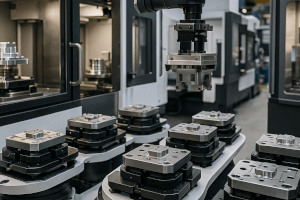
Palletization offers a solution that does not rely on finding more people. A well-designed pallet system allows a single operator to oversee multiple machines instead of being tied to one spindle. Jobs can be loaded offline, inspected offline, staged offline — all while the machine continues cutting.
Ten years ago, automation was a way to increase volume. Today, it is the only way to keep up.
Lead Times Have Become the Most Important Competitive Advantage
OEMs in aerospace, medical, defense, semiconductor, and energy markets have aggressively shortened their product development cycles. They no longer tolerate eight-week lead times or unpredictable deliveries. They need suppliers who can respond instantly, run revisions without delay, and scale up quickly with minimal notice.
Shops that rely solely on manual setups simply cannot match the responsiveness of a palletized system. A machine that transitions automatically from job to job without an operator is a powerful differentiator. It allows shops to run urgent prototypes during the day and schedule long production cycles overnight — something that was extremely difficult a decade ago due to tooling limitations, chip management issues, and unreliable cutting strategies.
In 2026, speed is everything. Palletization delivers it.
Technology Finally Caught Up With the Vision
Much of the technological foundation required for lights-out machining did not exist ten years ago. CAM systems lacked the advanced tool engagement algorithms that make adaptive toolpaths predictable. Tool life was inconsistent, simulation was limited, and monitoring tools were basic at best.
Today, AI-powered anomaly detection, spindle load monitoring, built-in tool breakage detection, real-time camera feeds, and predictive maintenance systems make unattended machining far safer and more reliable. Modern carbide geometries and high-efficiency toolpaths keep heat low and tool wear predictable. Coolant delivery, chip evacuation, and automatic recovery algorithms have improved to the point where multi-hour unattended cutting is not just possible, but expected.
The fear that kept shops from running lights-out ten years ago has largely disappeared because the tools now work.
Machine Tool Builders Shifted to Automation-First Design
One of the biggest reasons 2026 marks a different moment is that machine tool OEMs have fully embraced automation integration. In the past, adding a pallet system or robot often required custom wiring, PLC modifications, or third-party integration specialists.
Today’s machines include automation ports, standardized communication protocols, large tool magazines, built-in probing cycles, recovery logic, and automation-friendly controls. A VMC or horizontal from 2026 is fundamentally different from its 2016 equivalent, not because it cuts differently, but because it was designed to be part of a production cell instead of a standalone island.
This shift dramatically lowers the barrier to entry for automation.
Palletization No Longer Requires High-Volume Production
For decades, pallet systems were viewed as technology for automotive, aerospace, or other large-run environments. Job shops that run dozens of part numbers per week saw pallet systems as overkill.
In 2026, modular palletization has flipped the script. Now, a shop can load each pallet with a different setup, each optimized for a different part. The operator handles all changeovers offline, while the machine simply moves from pallet to pallet with zero downtime.
This model is perfect for the high-mix, low-volume reality of American machining. A single palletized 5-axis machine can outperform multiple stand-alone VMCs, not because it cuts faster, but because it never stops cutting.
This was simply not possible a decade ago.
Reshoring Has Created More Demand Than the Existing Machine Base Can Handle
The U.S. manufacturing renaissance has accelerated reshoring efforts. Industries like aerospace, defense, medical, and semiconductors are intentionally moving work back to American soil. The resulting surge in RFQs is straining the existing shop base.
Most shops cannot afford to add machines quickly enough, and even if they could, lead times for new equipment can stretch many months. With limited labor and long delivery times for new machines, palletization has become the fastest way to scale output without expanding the shop footprint or headcount.
It is now the most practical growth strategy — not a high-end option.
The Economics Are Too Strong to Ignore
Perhaps the most decisive factor is simple math. A typical CNC machine in a job shop runs about 30–40% spindle utilization. With palletization and lights-out workflows, that number can reach 60–75%.
For many shops, that means doubling output with the same machine, same operator count, and same floor space. The return on investment is almost immediate, especially compared to the cost of purchasing a new machine tool.
Ten years ago, automation ROI was unpredictable and often disappointing. In 2026, the ROI is consistent, fast, and compelling.
Why 2026 Is the Year to Modernize — and Why Waiting Is Dangerous
Every major shift in the manufacturing landscape creates winners and losers. The shops that adopt palletization and lights-out machining in 2026 will enter the next decade with:
- Faster lead times
- Lower operating costs
- Greater scheduling flexibility
- Higher throughput
- Stronger margins
- More attractive quoting
- Stronger relationships with OEMs
The shops that wait risk becoming uncompetitive within just a few years. Buyers increasingly ask whether suppliers run 24/7 automation. Lead times and throughput will define the market. Automation-enabled shops will win more contracts with less labor, while manual shops struggle to keep pace.
2026 is not simply another year of incremental improvement. It is the year where automation stops being optional. The cost, technology, workforce realities, and market pressures have aligned perfectly and CNC shops that seize this moment will define the new standard for American manufacturing.